Precision Boiler Diagnostic & Heating Restoration
Reliable heating is vital when coastal nor'easters and freezing winter winds sweep across South Brooklyn from Gravesend Bay and the Atlantic Ocean.
Local Heating Challenges in Gravesend Residential Properties
Gravesend is one of the original colonial towns of Brooklyn, known today for its quiet residential charm, solid architectural stock, and historic town grid. The neighborhood features a distinctive blend of detached single-family frame houses, multi-family brick rowhomes, and semi-detached properties built primarily between the 1920s and 1960s along Avenue U, Avenue S, Kings Highway, McDonald Avenue, and Stillwell Avenue.
The vast majority of these homes rely on cast iron low-pressure steam heating systems or multi-zone hydronic circulating hot water boilers. While cast iron vessels are exceptionally durable, South Brooklyn's coastal dampness and aging piping infrastructure place intense seasonal stress on electromechanical heating components. When sub-freezing temperatures arrive, slight mechanical wear—such as a calcified low-water cutoff float, a corroded pigtail siphon tube, or an oxidized optical flame sensor—can trigger an immediate burner lockout, leaving an entire residence without heat.
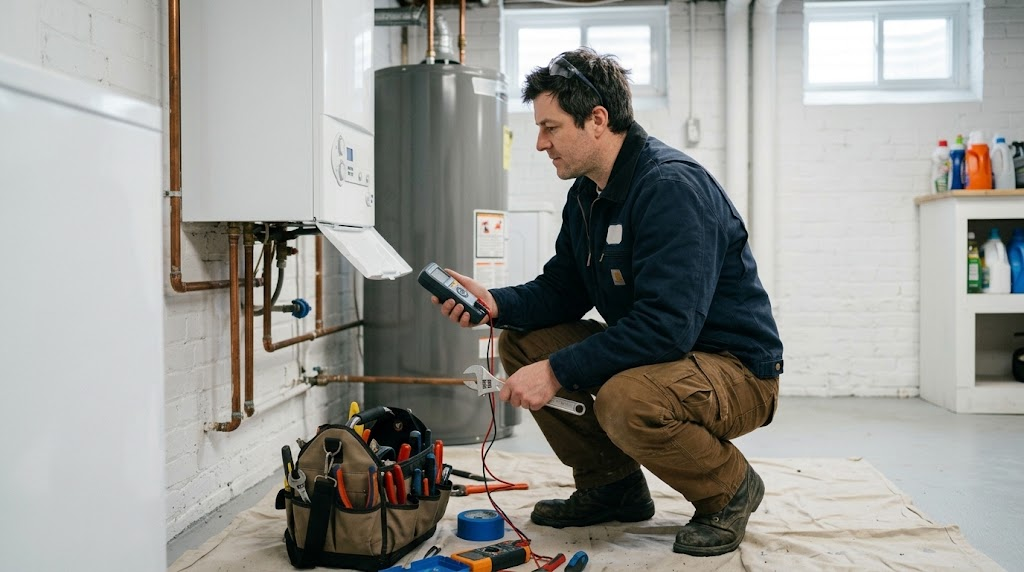
Our licensed heating technicians perform comprehensive diagnostic assessments rather than superficial patches. We test flame rectification millivoltage, measure gas manifold pressure, inspect flue drafts for carbon monoxide safety, calibrate electronic water feeders, and evaluate system pitch to restore quiet, balanced warmth across every floor.
Critical Warning Signs of Boiler Failure
Recognizing the early symptoms of boiler distress enables Gravesend homeowners to act promptly before severe winter freezes burst domestic water pipes:
- Complete Heat Failure (Lockout Mode): The burner attempts ignition, sparks or clicks repeatedly, and locks out on safety. Common causes include dirty flame rods, failed ignition modules, or defective gas control valves.
- Loud Kettling & Water Hammer: Severe knocking, metallic banging, or rumbling sounds indicate steam bubbles collapsing beneath mineral lime scale or boiler water surging into steam mains due to high TDS (total dissolved solids).
- Rapid Short-Cycling: The boiler fires up and shuts down every two to three minutes without warming upstairs rooms, indicating failing aquastats, seized circulator pumps, or waterlogged expansion tanks.
- Leaking Pressure Relief Valves: Water dripping or discharging from the ASME pressure relief valve warns of dangerously elevated operating pressure, thermal expansion failure, or defective auto-fill valves.
- Soot Accumulation & Irregular Flames: Yellow, lazy burner flames indicate incomplete combustion and soot formation, signaling restricted intake air and immediate carbon monoxide risk.
| Heating System Configuration | Operating Pressure Standards | Primary Diagnostic Test Points | Common Gravesend Neighborhood Issues |
|---|---|---|---|
| One-Pipe Steam Boilers | 0.5 – 2.0 PSI (Low Pressure) | Gauge glass clarity, Low Water Cut-Off (LWCO), pigtail siphon, pressuretrol differential | Sediment clogs in float chamber, spitting radiator vents, unpitched steam returns causing pipe hammer |
| Hydronic (Hot Water) Boilers | 12 – 20 PSI (Closed Loop) | Circulator pump amperage, bladder expansion tank charge, zone valves, high-limit aquastats | Air-bound upper baseboards, stuck zone valve motors, dripping thermal relief valves |
| High-Efficiency Modulating Boilers | 15 – 30 PSI (Modulating) | Condensate trap neutralization, concentric direct-vent clearings, secondary heat exchanger cleaning | Condensate drain line freezing in unheated basement entries, flue acid buildup |
The Gravesend Boiler Diagnostic & Repair Process
When you call our emergency line at (315) 202-8009, our technicians follow a rigorous diagnostic protocol to ensure reliable and code-compliant heating restoration:
1. Safety & Electrical Check
We verify emergency shutoff switch integrity, test line voltage, inspect transformer secondary windings, and confirm that limit switches and low-water cutoffs are operating correctly.
2. Combustion & Gas Delivery
Our technicians test gas manifold pressure, inspect electronic ignition spark or hot surface igniters, measure flame signal microamps, and calibrate the burner assembly for clean combustion.
3. Hydronic & Steam Trim
We flush sight glasses, clear pigtail pressure siphon loops, inspect automatic water feeders, bleed trapped air from hydronic baseboards, and verify expansion tank pre-charge.